



Hello, friends. This is one of my very favorite interviews I’ve done, with the gracious, wise, and brilliantly impressive Nicholas Thompson. I discovered him via his book, The Running Ground, just the night before I ran the New York City marathon in the fall (my first ever race).
One of the many highlights here is our discussion on whether I (by way of Dialectic) am a journalist (intro, and around 26:27). Nick gave the best answer I’ve heard.
Also, 22 favorite lessons from him below. Please enjoy. Full transcript at dialectic.fm/nick-thompson.
If you like it, please give the episode some love here on Substack and on Youtube, Spotify, Apple, X/Twitter, Linkedin
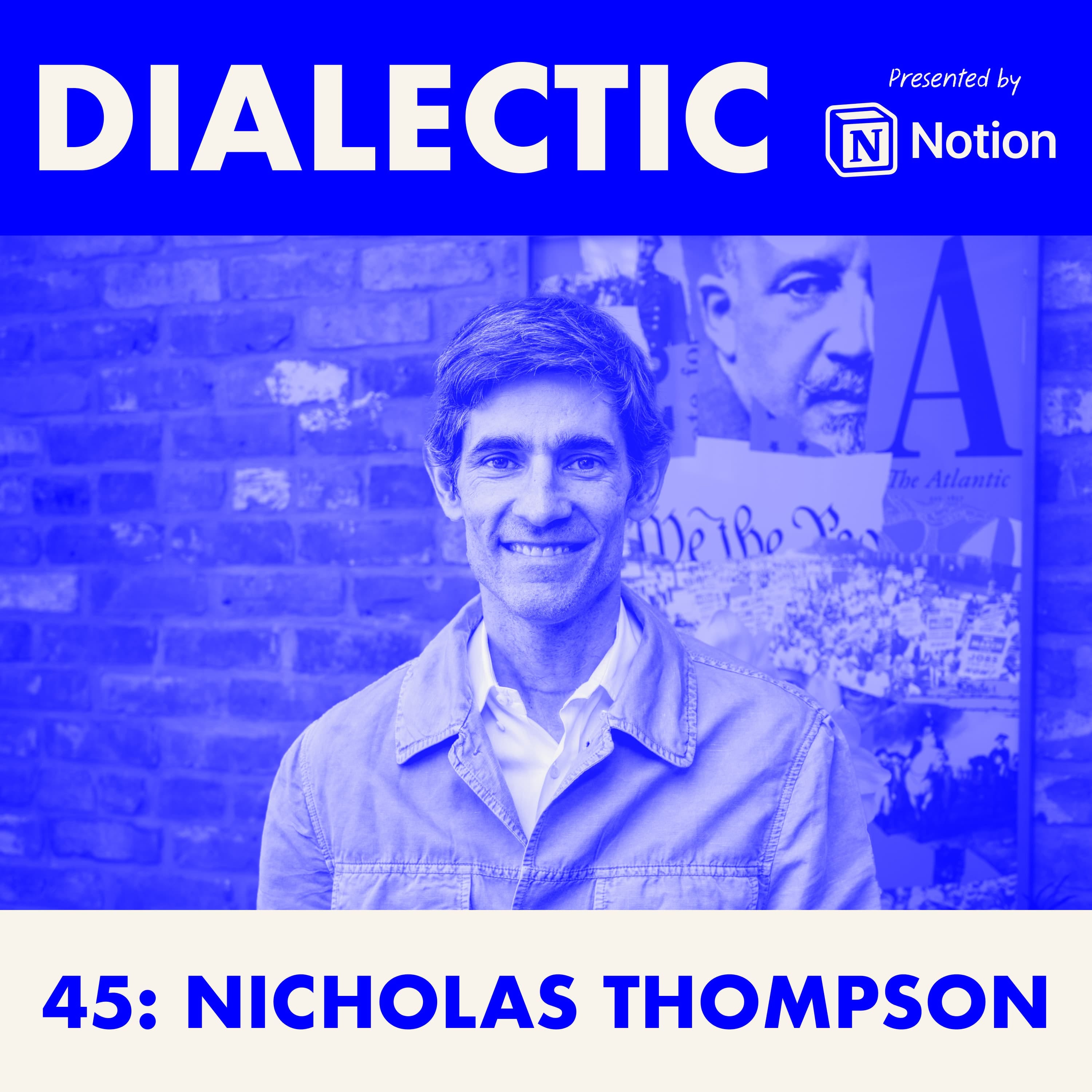
Dialectic 45: Nicholas Thompson - A Life of Long Form
22 Lessons from a Life of Long Form: Nick on Words, Running, and Inheritance
A book is common ground. Hand someone a book and they read the exact same words you did, in the same order, with no distractions. Two AI prompts return two different texts. A book is the rare artifact you can share, annotate, and argue about, because the words don’t move.
Style is the byline you can hear. The writers Nick loves all sound nothing like each other. He used to play a game at The New Yorker: read the unsigned Talk of the Town and guess the author by the voice alone. Models can’t do that yet, because models are pulled toward consensus, and great writers pull away from it.
Reporting happens in hallways, not prompts. Adam Serwer gets sources to talk who have every reason not to. No model with voice imitation is doorstopping a hostile attorney general.
AI hasn’t turned sixes into tens. Nick has watched good writers use it and produce good work, and bad writers use it and produce bad work. The interesting moment, which hasn’t arrived: the writer with six out of ten skills using the tools to fill in the other four.
Democracy runs on shared stories. A country can’t argue well without facts to argue about, and shared stories are how those facts travel. The autocracy playbook in Hungary, Turkey, and Russia is the same three moves: arrest the journalists, buy the publications, shut down the critics. More truth in the world means longer odds against that ending.
A journalist’s first loyalty is the audience. Nick’s working definition: if your primary commitment is to your audience, you’re a journalist. If it’s to your guest or your advertiser, you’re something else.
Constraints are a gift. When Laurene Powell Jobs told The Atlantic to stop bleeding money, Nick called it a gift. Forced choices about what to pay for, what to cut, and what to refuse to subsidize are the choices that produce great work and long-term survival. Bottomless pockets quietly bankroll mediocrity.
Skepticism follows power. Elon Musk in 2008 was a scrappy guy making cars; Elon Musk now is the richest man alive with an empire. Same Elon, mostly. Same press, mostly. The observers’ disposition changed because the power did, and skepticism of power is part of what journalism is for.
America is a conversation before it is a consensus. Nick’s myth of America is not blood-and-soil nationalism. It is a place where people from different backgrounds can still find each other in little towns, big ideas, football Sundays, Fourth of July rituals, and stories worth crossing the road to hear. He wants to run across it one day to prove it.
Editing is partnership, not polish. A great editor does not arrive with a tiny broom for commas. They find the false beginning, the structural hole, the place where the reader has not yet been given a reason to care. They see what you can’t see in your own work. This is what The Atlantic gives you that Substack can’t: a partner who has done this hundreds of times.
Set the bar for whoever is jumping. David Remnick’s line, kept by Nick from his New Yorker years: “If the writer can only jump over a six-foot bar, your job is not to try to get them over a seven-foot bar. Your job is to get them over that six-foot bar.” Excellence is not an impossible standard. Excellence is the best version of what is actually in front of you.
Subtract the daily decision. Nick runs every day because the core decision has already been made. Rain gets a jacket, heat gets a thinner shirt, but the excuses don’t give him an out. “It’s very helpful to have a stoic philosophy of just doing it.”
Everyone is running a different race. Cliche but true. Nick fell apart at the 2004 Boston Marathon, walked ten miles, and finished in 3:43, looking like death. The woman next to him was celebrating — she’d been chasing 3:45. In thirty-three years of competitive running, he’s won three races, and there is only one winner. The race is with yourself.
Tiny tailwinds compound. Nick’s dad on momentum: “When you have it, keep it, and use it; when you don’t, try to get it back.” Maybe it’s by doing ten pushups or watering the plants. It could be writing the thank-you note you’ve been avoiding for a week. “Every time we do something right, we create a tiny, imperceptible tailwind for the future.”
The faster self was always in there. Nick ran 2:43 marathons over and over in his 30s and assumed that was the ceiling. At 44, with the right coach, he ran 2:29. He carried a post-cancer self-conception for fifteen years without knowing the door was unlocked. As with the yellow canoe he watched sit on a balcony for years that never touched water, “I wondered then, as I wonder now, what other versions of me exist that there may no longer be time to find.”
Race hard. Run free. Race day is full intensity. For the other days, he aims to be lighter. Simple commutes in stride. Runs in the mountains with no music, just birds and breath. He admires Kilian Jornet: “The people racing [him] hate it. He’s just having fun in the mountains. Then he wins.” Nick tries to live in the gap between the man with the bib and the man on the trail.
He whom the gods wish to destroy, they first make promising. Scott Thompson — Nick’s father — was a Rhodes Scholar, tenured at 27, told by JFK he’d be president. Nick won the same kind of awards at Stanford and then got fired from his first job, kidnapped in Africa, and rejected from a hundred internships. “My dad didn’t get punched in the mouth professionally until much later.” That gap may be the whole difference.
You inherit the material, not the ending. Nick knows he is his father’s son: the intellect, the scattered energy, the appetite for many things at once. But he also watched appetite without discipline do damage, and built part of his life as a vow to break the “long string of Thompson fathers who have caused deep psychic angst for their children.”
Bank memories while you can. On his fiftieth birthday, Nick’s fifteen-year-old son paced him to a sub-five-minute mile. Soon, his son will be faster. Eventually, Nick will decline. The point of being a fit father isn’t to outrun aging; it’s to leave a memory his kid can pull on when Nick is seventy-five, or gone.
Always green lights. Nick’s father Scott “loved life. He wanted to talk to people, do things, and get more experience. He hated boredom and couldn’t slow down.” He grew up in Bacone, Oklahoma, died near Lake Taal in the Philippines, and was everywhere in between. He could talk to a seventeen-year-old on the street and a prime minister, and he’d bring them together. The lesson Nick took from his father isn’t only what to avoid. It’s the verve for life.
Sleep on the roof. Nick slept on the roof of his Stanford dorm every night in college, and at fifty, he still keeps a mantra: if you can do something outside, do it outside. What makes him most alive now is the same thing that made him alive then. Off the phone, in motion, under the sky, with people he loves.
The work of being here is the work that’s left. Nick’s favorite closing lines, from a Graham Burnett essay in The New Yorker: the machines can imitate almost everything except what it is like to be us. “This remains to us. The machines can only ever approach it secondhand. But secondhand is precisely what being here isn’t.”
Description
Nicholas Thompson (X, LinkedIn, Wikipedia, The Atlantic) is the CEO of The Atlantic, an elite distance runner, and the author of The Running Ground—a memoir about his father, his life, and the sport of running.
Nick has led The Atlantic to tremendous subscriber growth and profitability since joining the then-money losing publication in early 2021. He was previously editor-in-chief of WIRED and editor of newyorker.com. He also co-founded The Atavist, wrote The Hawk and The Dove, and is a prolific interviewer, including his latest series, *The Most Interesting Thing in AI.* Nick is also the American record holder in the 50K, which he re-broke two days after we recorded this conversation (Exhales).
We talked about the future of words in the age of AI, what makes a journalist, why legacy media institutions like The Atlantic are worth fighting for, and what great editing and coaching have in common. Then we turned to running and life: the small tailwinds that compound beyond what we can imagine, Nick’s trajectory—through a prodigious start, early career failure and African kidnapping, cancer at 30, and wild success since—to name a few beats, the trials and blessings of inheritance, and the versions of himself he may no longer have time to find. To close, Nick honors Scott Thompson’s memory by sharing how we might all be more like him and reflects on what drives aliveness.
I hope you are inspired to get started, feel the wind at your back, clear unexpected hurdles, savor great words, raise your bar beyond what is reasonable, be grateful for those who came before and pay it forward to those who are next, and remember that there is always more waiting—for you, for me, for us.
P.S. It’s unrelated to this conversation, but please read The Atlantic’s latest cover story and one of my favorite (and funniest) things I’ve read in ages. Caity Weaver on The Best Free Restaurant Bread in America. Long live long form writing.
Dialectic is presented by Notion. Notion is an AI-powered connected workspace where teams think together and create their best work. Notion recently launched custom agents: helpful AI teammates that handle recurring work across your entire suite of tools. Automate you and your team’s repetitive tasks so you can focus on the deep work. You can learn more at notion.com/dialectic.
Timestamps
0:00 Opening Highlights
1:17 Intro to Nick
2:24 Thanks to Notion
3:30 Start: Words, Reading, and Writing in an Automated World
18:39 Why Stories Matter and What Makes a Journalist
28:22 Media Institutions, The Atlantic, Democracy, Tech, and Power
44:21 Retaining Great Writers and The Virtues of Editors (and Coaches)
57:44 Magazines and America
1:05:57 Running, Motivation, Momentum, and Tailwinds
1:16:08 Aging, Fathers and Sons, Inheritance, and a Mother’s Grace
1:31:00 Merging Machine-like Discipline and Wild Curiosity, The Boat that Never Touched Water, and Who We Might Still Become
1:44:11 Gratitude, Stalin’s Daughter, Scott Thompson’s Verve, and Feeling Most Alive
1:52:40 Closing and Thanks Again to Notion
Key Links & References
The Running Ground - Nick Thompson
Why I Run (excerpt from Running Ground) - Nick Thompson for The Atlantic
Not Fade Away book - by Laurence Shames and Peter Barton
Writer Evan Ratliff Tried to Vanish: Here’s What Happened (Wired)
Will the Humanities Survive Artificial Intelligence? - D. Graham Burnett for The New Yorker
All links and transcript available at dialectic.fm/nick-thompson.


