


Patrick Hsu is a co-founder and a core investigator at Arc Institute, a new type of biomedical research organization. He and Arc are combining biology, engineering, and AI to turn a sci-fi future into reality.
Patrick got expelled from college at 13, returned at 15, later worked on early CRISPR breakthroughs, and teamed up with Silvana Konermann and Patrick Collison to co-found Arc.
He works 3 jobs: core investigator at Arc, professor at Stanford, and venture partner at Thrive Capital. For all his intensity and ambition, he carries a lightness and boldness that is contagious.
We discuss:
why research is 99% failure and even your best ideas kind of suck
infinite games and speedrunning school
the reach of GLP-1s and power laws in biotech
what makes a good biologist
Arc’s bet on people over projects
lab robots that finally work
AI-designed organisms and new forms of life
why heart disease could go the way of infectious disease
bro science, peptides, and biofuturism
research taste in the age of AI
Please enjoy. Available on Spotify, Apple, YouTube, X, Transcript, and here on substack.
Dialectic 60: Patrick Hsu - Speedrunning the Infinte Game
Description
Patrick Hsu (X, Website, Arc lab) is co-founder and core investigator of Arc Institute, assistant professor of pathology at Stanford, and venture partner at Thrive Capital.
Patrick has always been precocious: he began college as a young teenager and contributed to early CRISPR-Cas9 gene-editing breakthroughs as part of Feng Zhang’s lab at the Broad Institute of MIT and Harvard. Today, the Hsu Lab at Arc works where genome engineering meets AI, from bridge recombinases that can rearrange up to a million bases of DNA at once to Arc’s Evo biological foundation models.
We discuss Patrick’s pace and ambition, infinite games, and why he was drawn to biology. Then, we traverse power laws in biotech and the reach of GLP-1s, research taste and success, Arc’s multidisciplinary model, data limits in AI-enabled bio, and cell and bio foundation models. We also discuss how AI and new science will help us solve diseases, design life, and push the boundaries of sci-fi when it comes to human health. I hope you are inspired to raise your bar, commit to reinvention, and hold a lightness that makes the long and challenging journey fun.
Corrections:
Periodic Labs (41:13): Patrick said “room-temperature semiconductors.” He meant superconductors.
Yamanaka’s Nobel (1:03:44): Patrick said 2009. Yamanaka won the Nobel in 2012, for reprogramming factors discovered in 2006.
Dialectic is presented by Notion. Notion is a collaborative workspace for your life’s work, and it works with whatever AI you use. New models are typically available in Notion the day they launch, you can tag agents from inside Notion, and you can tag Notion from your other AI tools. As the tools around you change, Notion stays the one place that holds your context. Notion is also hiring across product, engineering, design, storytelling, and more. Learn more at notion.com/dialectic.
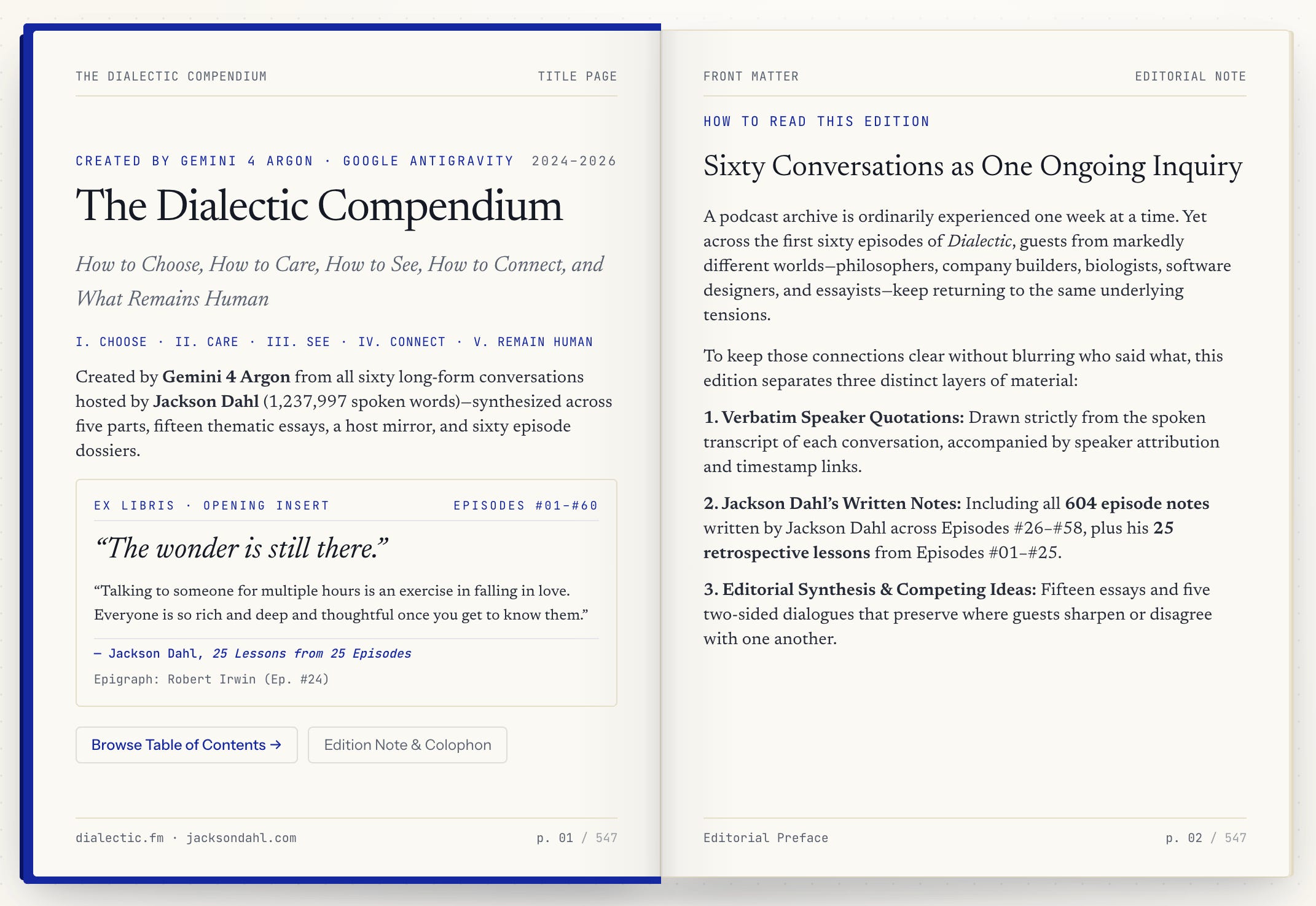
This episode is supported by Google. Gemini 4 Argon recently launched and is built for long-horizon work. I used it inside Antigravity and gave it all 60 Dialectic transcripts: more than a million words. Instead of summarizing episodes one by one, Argon synthesized across them, tracing how ideas from early conversations connect to later ones. Together we made The Dialectic Compendium, an interactive book of the themes that run across the show, with a dossier on every episode and a 3D version you can page through on the web. Gemini 4 Argon is available in the Gemini app, Antigravity, Google AI Studio, and the Gemini API.
Compendium: https://jacksondahl.com/dialectic/compendium
Timestamps
(0:00) Opening Highlights
(1:39) Intro: Patrick Hsu
(4:29) Start: Boldness, Infinite Games, & Ambition
(12:54) GLP-1s and Power Laws in Biotechnology
(20:17) Expelled at 13 and Falling for Biology
(25:51) What Makes a Good Biologist, Research Taste, and Biology’s Data Challenges
(37:58) The Arc Model: Full-Stack Science
(52:01) Betting on People, Style, & Learning to Simplify
(57:22) Perturbation, World Models, and Evo
(1:03:27) Virtual Cell Models
(1:09:56) Designing Life: From Stem Cells to Genome Writing
(1:18:39) Testing, Bro Science, and Human Data
(1:24:26) Can It Exist vs. Will It Exist: Science Meets Markets
(1:29:59) Biofuturism: Interoception, Peptides, Muscle Modulation, Sleep, and New Forms of Life
(1:43:47) Fun, Obsolescence, Going Slow, and the Future


