


Miles Grimshaw has spent his life hunting change: from “adventure racing” to finding and working with the world’s most ambitious software companies.
His favorite part: getting to go back down the mountain and begin again.
Now, he faces an existential question: AI is making software creation nearly instant and free. All of the underlying assumptions for venture-backed software startups are in question. What moats will persist? Is software over?
I talked to him about playing infinite games, seeing greatness up close, and endurance in finding the next hill to climb.
Available on Spotify, Apple, YouTube, Twitter/X. If you enjoy it, please share it with a friend :)
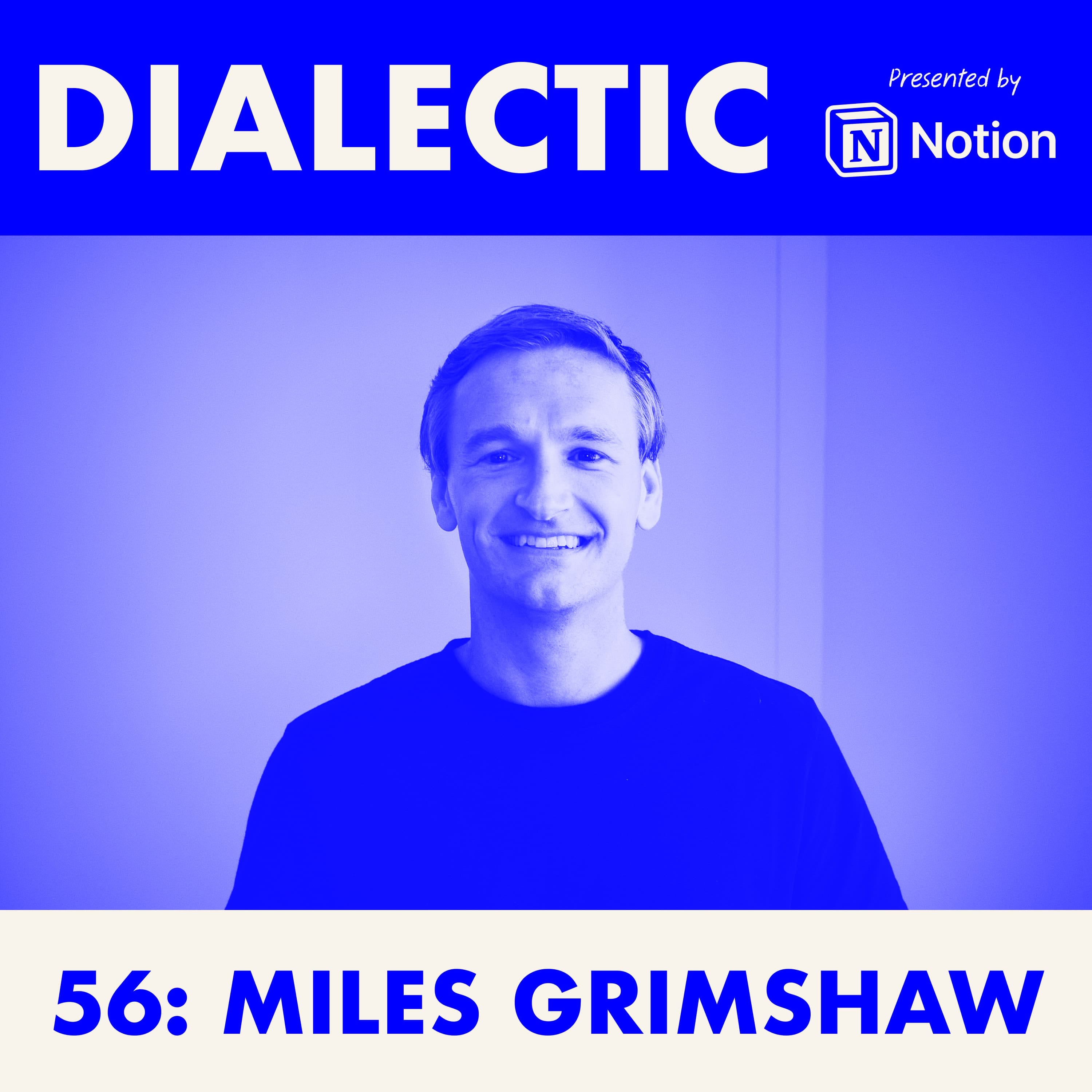
Always Another Adventure: 21 Lessons from Miles Grimshaw on Software’s Future, Enduring Companies, and Being Impatiently Patient
Miles Grimshaw is drawn to beginnings: the new country, the unfamiliar market, the next mountain. I talked to him about how he finds and partners with exceptional people, which genetics shape enduring companies, what moats will survive in software, and beginning again, over and over.
The reward for reaching one summit is another climb. A coach sent Miles Camus’ classic essay imagining Sisyphus happy. He’s internalized it with regard to his infinite game as a venture investor: “I love going back down and looking at new summits and going, ‘Can we go do that one?’”
Courtship starts before the round exists. Miles flew to Ottawa after one call with Turbopuffer’s CEO Simon, offered him a term sheet, got turned down, and spent more than a year helping out anyway. When the call finally came at 9:30 on a Monday night, Thrive was committed by 10:30. “Our challenge is to be impatiently patient.”
Underwrite the person before the model. Miles invested in Cursor after getting rough numbers over dinner without ever receiving detailed revenue numbers. “It never starts with a spreadsheet. It starts with that person, the future that they see.”
Investing is enlisting. Miles treats early investment like joining the team and working for that ownership over the next decade. After Cursor’s Series A, Thrive went all-in on recruiting for them through the Series B. The relationship is working when a founder thinks, “Sure, I want to raise money from these people, but actually, I kind of want them on the team.”
Instinct comes from exposure to the best. Your read on great is only as good as the greatness you’ve seen up close. When Thrive met Mesh Optical (a team who built Starlink’s laser interconnect at SpaceX), they went from first meeting on Friday afternoon to commitment by Monday, all in a domain they “had no business knowing anything about.”
Specific optimism is the job. He once told a candidate, “There are infinite ways this can go wrong that I can enumerate. Our job is to figure out the path of it going right.”
What is it? And who cares? Two questions underpin Miles’s investment analysis. You can say many words about a company, but if you can’t simply define what the customer is actually buying and who values it enough to pay, nothing else matters.
Vision is where the founder is looking. Patrick Collison was looking beyond payments toward the GDP of the internet; Cursor’s Michael Truell was looking beyond the IDE toward new abstractions for coding. “In driving and biking, you go where you look… I think that is really true for companies, too.”
Ask what a company’s growth is made of. Investors love to use a company’s ARR growth as a scorecard: how fast to $10M or $100M? Miles is less interested: “That’s a phenotypic expression of an underlying set of genetics.” A handful of large contracts or a long tail of small customers might both have strong ARR, but will grow into completely different organisms.
Pick the customer that helps you live in the future. For early-stage companies, he cares more about demanding, innovative customers than pure revenue. They force the product and the organization to adapt to a changing market. “I think Stripe would be a very different company if Delta was its first customer instead of Shopify or Lyft.”
A great product can outrun its sales team. When he began working with Cursor, it got to tens of millions in ARR with zero salespeople. The sales team remained very small until early 2026. Michael relied on his team’s feedback and individual user conversations because “they had a very strong purity to delivering a great product.”
Copy the cause of success, not its privileges. Google’s core business was so powerful that 20% time could look like a management principle instead of something Google could uniquely afford. “In some sense, it was the wrong thing to learn the lesson of from that company.”
Software’s hidden moat was wall-clock time. Switching costs mattered, but Miles thinks the undercounted advantage of software was the years spent building a place where customers, integrations, expertise, and mindshare naturally gathered. “The great software companies basically built a city... If you’re Benioff and you’re building a CRM, sure, you’re building a CRM, but you’re kind of building the City of Sales.”
Get big or go luxury. AI has compressed the build time that protected incumbents in software, threatening the middle. Miles suggests a lesson from ecommerce: either cover enormous surface area or be nimble enough to build bespoke, white-glove products.
Craft creates trust. Customers may not consciously notice every product decision, especially as software becomes more like services. But they feel the accumulated attention to detail and infer that the invisible details have been handled with equal care.
“I don’t know” is only half the answer. The follow-up is “I’ll figure it out.” Learning requires enough humility to say “Sorry, I just don’t understand that” and enough self-confidence to believe you can reach the ground truth.
Instinct must become legible before it becomes useful. Repetition improves Miles’s intuition, but an investment team cannot act on a feeling trapped inside his head. “If I can’t communicate it to the people who trust me the most… how is the rest of the world going to do that?”
Raise the ceiling in good times and absorb the shock in bad ones. A lesson from Sequoia’s Sir Michael Moritz. Success gives a company the capacity for the exceptional recruit, ambitious customer, or defining move: “when things are working, you need to set your eyes further out.” In adversity, the founder has already felt every problem more deeply than the board will, so constructive support is more useful than drilling on known problems.
Hold jam sessions, not jury trials. He rejects the investment committee as a jury trial where one person presents, and everyone else looks for guilt. “The best version of investment team conversations… is like being in the music studio making music together.”
Stable foundations make larger adventures possible. Miles spent much of his life associating the next adventure with leaving: England, the US, India, China, a new major at the end of college, then Thrive for Benchmark. Returning taught him something else: “I’ve come to find a lot more of the magic that gets unlocked by a strong foundation.”
Endurance grows from evidence, not encouragement. Miles ran his first marathon at seventeen because he wanted to do it before turning eighteen; years later, he and his wife completed a 150-mile race in New Zealand that half the field did not finish. Belief follows proof: “Once you know you can, you can.”
Description
Miles Grimshaw (X, LinkedIn) is an investor at Thrive Capital. He’s spent most of his career there, there, partnering with founders at the early stages of company building, including Cursor, Turbopuffer, Chai Discovery, Mesh Optical, Revel, XDOF, Socket, Benchling, GitHub, and many more. Miles was also briefly an investor at Benchmark before returning to Thrive in 2024.
The conversation focuses on Miles’ appetite for change and continuing to begin anew, again and again. That starts with “adventure racing” as a teenager, and continues through his career as an investor in search of world-changing companies.
We talk about how Miles proactively puts himself in position to work with great founders in a style that resembles courtship, his disposition of impatient patience, and why he loves change. The latter includes the dramatic shift in his primary domain: software. As the underlying assumptions for software businesses change due to AI, what traits will great companies have? And what moats if any will persist? Is software investing over?
Miles also talks through how great companies and founders go where they are looking, prioritizing customers that help you live in the future, the learned intuition of greatness, and joining the expedition squad alongside the founders Thrive partners with. Finally, we talk a bit about Thrive, his departure to and return from Benchmark, and endurance.
I hope you are inspired to find an infinite game where you are excited to see the stone roll back down the hill and begin to push again.
Disclaimer: This podcast is for informational purposes only. The views expressed are the speaker’s own as of the recording date and are subject to change. Thrive funds and their affiliates have investments in certain companies discussed in this episode. References to those companies are illustrative, do not represent all investments made by Thrive, and should not be viewed as recommendations or indications of future investment performance. Past performance is not indicative of future results.
Dialectic is presented by Notion. Notion is an AI-powered connected workspace where teams think together and create their best work. Notion’s custom agents are AI teammates that handle recurring work across your tools. Learn more about their new developer platform and workers here. Notion is hiring across product, storytelling, design, engineering, and more. You can learn more at notion.com/dialectic.
Timestamps
(0:00) Opening Highlights
(1:37) Intro: Miles Grimshaw
(4:30) Infinite Games, Adventure Racing, and Starting Anew, Over and Over
(11:01) Staying Hungry: Proactive Hunting and the Turbopuffer Story
(17:35) Impatiently Patient: Courtship, Cursor, Recruiting, and Joining the Team
(25:33) Loving Change: London to America, the Himalayas, and Learning New Sports
(31:36) The Genetics of Companies: “What Is It?” and “Who Cares?”
(38:08) House Cats & Tigers: Where Is the Founder Looking?
(47:00) Confidence in Uncertainty and Customers That Pull You Into the Future
(54:25) What Remains for Software: Moats, Cities, Wall-Clock Time, and the Barbell of Scale & Luxury
(1:04:54) Craft, Trust, and Why Software Isn’t Over
(1:11:13) Intuition: Gradient Descent and Seeing Greatness Up Close
(1:18:07) “I Don’t Know” and “I’ll Figure It Out”
(1:22:12) Commitments, Not Bets: Closing People and Board Work
(1:29:06) Joining Thrive, Being a Punk, and Music Studios over Jury Trials
(1:36:18) Leaving for Benchmark and Returning to Thrive
(1:43:18) Dream Bigger: Lessons from Josh, Teaching Agency to Kids, and Going the Distance
(1:51:36) Outro


