


Ryo Lu is hilarious, charming, and doesn’t care about your ideology. He is also living his best life: he leads design at Cursor, where he has reminded himself of what making things felt like before he was a “professional product designer.” For him, that makes working with code itself, the raw material of our digital lives.
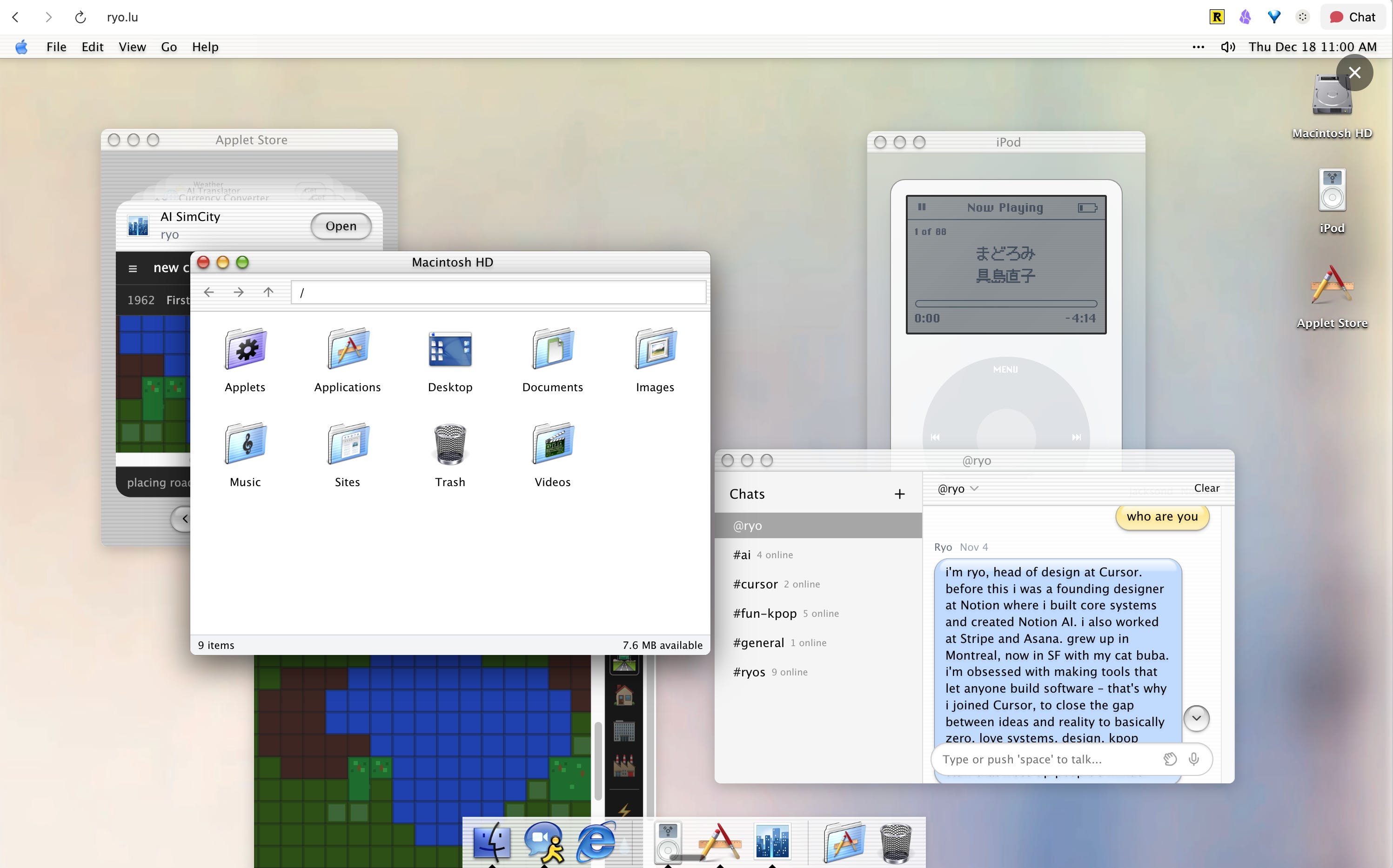
There’s no better example of his approach to creativity and design than his personal project, ryOS, which he created with Cursor. Take a look, or better yet, give it a try.
Dialectic 34: Ryo Lu - It’s All the Same Thing
Dialectic Episode 34: Ryo Lu - It’s All the Same Thing - is available on Spotify, Apple Podcasts, and YouTube, and all podcast platforms.
14 Lessons From Cursor’s Ryo Lu on Iterative Creativity, AI, and Soulful Design
1. It’s all the same thing. Everything—apps, organisms, ideas—is built from simple parts that recombine into complexity. In many ways, design is pattern recognition plus taste in how you remix the fundamentals.
2. Get close to the material. You learn by making, not planning. For software makers, that’s code, at the most basic level. For creatives, it’s testing whatever medium gives feedback: clay, prototypes, rough cuts. Mocks and renders show possibilities. Prototypes show reality.
3. Greatness is emergent. It only looks inevitable in retrospect. You always start with shit. But because it exists, it can be improved. For Ryo, design feels like shaping clay or finding David in the marble. Poke, prod, ship, and quality sharpens into shape.
4. Simplicity is earned, not given. “Simple” design is achieved by wrestling with complexity and compressing it into a digestible form. The swan glides elegantly because it’s paddling like hell underneath. Easy is what comes after hard.
5. Design is making things true. Not polish. Not more details. It’s asking: what are the essential qualities of this thing? And then making them better, continually.
6. Learn to communicate at different altitudes. A prototype and a spec doc are the same thing, just at different levels of abstraction and in different flavors. The fundamental goal is translating ideas into forms people can absorb, and eventually use.
7. Great systems flirt with chaos. Push right up to the edge of collapse, then rein it back. You want weirdness, divergence, slack; just shy of too much. Don’t snuff out the new too soon.
8. AI is raw material, not finished goods. The purple gradient the AI tools give you is just the beginning. The difference between slop and soulful products is iteration and taste. Most people stop at the first output, rather than using it to begin.
9. Don’t dumb things down. Give users pro-grade tools with beginner-friendly packaging. Discovery beats prescription every time. Get out of the way and let users surprise you. Treat their growth as journey you accompany them on, and build affordances along the way.
10. Build bricks, not readymades. AI is really good at composing parts, so build great bricks. Agents without guidance reinvent the wheel, so give them consistent, reliable materials to work with. Remember: There’s no such thing as “the final design.”
11. Tenderness is care made visible. Understand what people need and are frustrated with. Build tools that amplify their strengths while erasing drudgery. Good design is generous.
12. A band of pilgrims, not conscripts. Teams that build greatness don’t hide behind convoluted processes or bloated hierarchies. They’re there because they truly love the work. And you can tell: they talk about ideas and impact, not valuations and vesting cliffs.
13. Become irreplaceable. AI is trained on all public knowledge. You’re trained on what you’ve experienced and how you respond: your taste, judgment, how you feel. That gap is what makes you distinct, and thus valuable.
14. Start anywhere. Compound everywhere. Small ideas stack up. You don’t need permission or a grand vision. Make a choice, observe, then make it better.
Description
Ryo Lu (Website, X) is the head of Design at Cursor. Prior, he was a designer at Notion, Stripe, and Asana, working on some of the most influential software tools of the last decade. He is now focused on building the next generation of tools for making software.
Our conversation is an extensive exploration of Ryo’s design philosophy, which is anchored in his recurring mantra: “it’s all the same thing.” He sees the world as fundamentally modular, where simple rules and patterns endlessly recombine to create emergent complexity. For Ryo, design is consciously participating in this process: seeing through the surface to understand the underlying structure and rearranging it into new forms. This means constantly moving between simplicity and complexity, chaos and order, bare material and highest levels of abstraction.
We discuss how his process has evolved with AI. In the past, designing in tools like Figma felt like painting; now, working in Cursor feels like sculpting clay or finding David in the marble. So much of his philosophy is about getting closer to the material—in this case, code—and letting it provide feedback. There is no better example of this than his personal project, ryOS, a nearly full-on operating system he built entirely in Cursor. It is soulful, deeply personalized, and the opposite of “AI slop.”
This is a philosophical discussion about designing things that feel “true” or even “inevitable,” but it is also a practical one. We talk about balancing agility and quality, allowing for “slack” in systems, and how to create soulful things with AI. Ryo is a profound thinker, but he is also a prolific doer, and it is this marriage that makes him so effective. I hope you are inspired to get closer to your own material, to be more flexible and dynamic, and to expand the boundaries of what you can personally create.

Dialectic is now presented by Notion. I am now focused on Dialectic full-time, thanks to their support. You can read more about why Notion embodies Dialectic’s values and our partnership announcement here.
Notion is an AI-powered connected workspace where teams build their best work. Notion is also where I compile research for episodes and the home of my new site where you can find all links and transcripts.
Timestamps
0:00: Notion Announcement & Dialectic’s Future
4:45: Intro
7:46: “It’s all the same thing!”
17:25: Technical and Conceptual Readiness and How AI Helps us Deal with Complexity
20:58: Designing for true-ness and inevitability
27:28: Practicality and False-Compromise
33:45: Working with Material and Different Ways of Thinking
44:06: ryOS and Designing for the Full Spectrum of Users
59:39: Allowing for Slack and Some Amount of Chaos in Design
1:04:55: What is Cursor, Conceptually?
1:10:33: How Using Cursor Evolves
1:15:50: Designing for Power While Not Alienating Users
1:19:59: How Ryo Designs at Cursor: Abstractions, Writing, Prototyping
1:23:57: Process, Creating Soulful Things with AI, Refining Taste
1:31:08: Balancing Agility and Quality, Chaos and Order
1:37:00: Great Teams and Great Products
1:39:41: Grab Bag: Human Tech, Why Tools Need Stories, Why Cursor Isn’t a Slot Machine, Notion & Cursor, Steve Jobs, Liquid Glass
1:56:16: Tenderness & Empathy
Links & References
Dialectic #12: Che-Wei Wang & Taylor Levy (CW&T) - Iterating Together with Time
in the age of ai, the question everyone’s asking is “will i be replaced?”
Full transcript available at dialectic.fm/ryo-lu


