


A few years ago, Blake shared a podcast that I’ve come back to many times and recommended constantly: C. Thi Nguyen on Ezra Klein.

Today, I continue that conversation in the interview seat myself. C. Thi Nguyen is a professor of philosophy focused on games, data, and metrics. I visited him to discuss his new book, The Score: How to Stop Playing Someone Else’s Game.
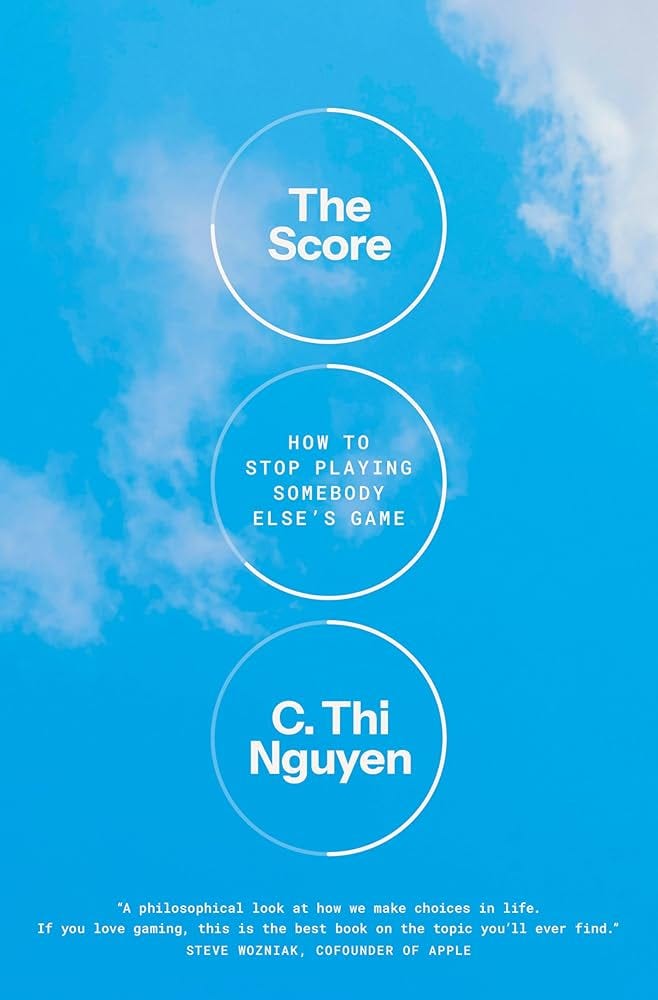
Thi is focused on a dilemma with scoring systems:
1) in games, they’re are great: they allow game designers to sculpt the player’s agency. By shaping goals, abilities, and obstacles, action becomes easy, even harmonious. The player can try on different roles, explore different values, and move “lightly between worlds”
2) in the real world, scoring systems flatten us. We’ve quantified our lives, and easily countable metrics produce what Thi calls “value capture.” By obsessively measuring what matters, we only value what we can easily measure.
I went deep with on the personal and societal implications of this.
What are different types of agency? What is the shape of good values? What is the difference between recognition and perception?
How can we be more playful, in and out of games? How can we find more beauty in process, not outcomes?
How can we trust each other, keep bad actors in check, and not extract nuance out of complex fields by relying too much on legible data?
Are objectivity and truth the same thing? Is technology really value-neutral?
I’ve also included some favorite lessons from the episode below. Enjoy!
Dialectic Ep. 36: C. Thi Nguyen - Measurement, Meaning, and Play
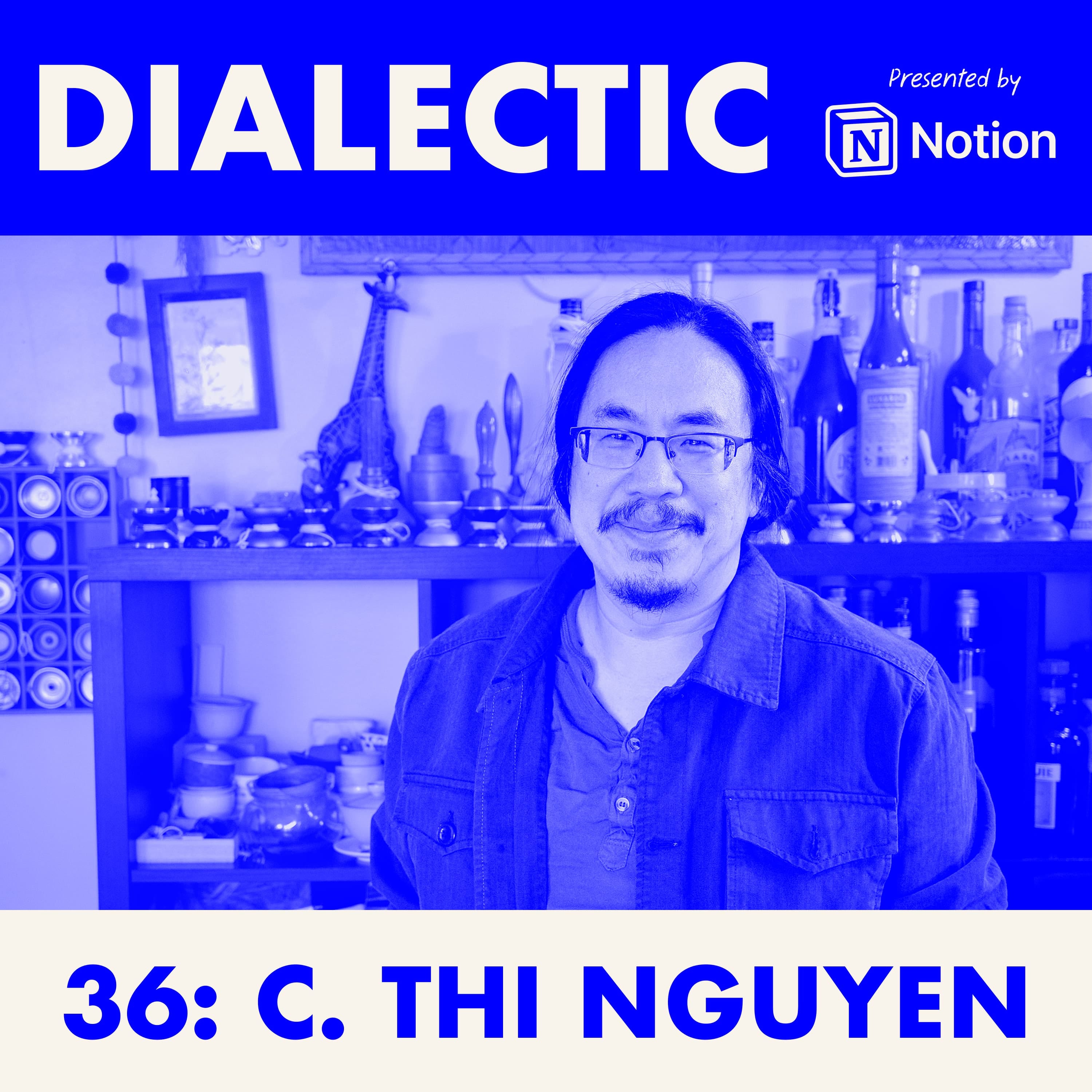
Dialectic Episode 36: C. Thi Nguyen - Measurement, Meaning, and Play - is available on Spotify, Apple Podcasts, and YouTube, and all podcast platforms.
18 Lessons from C. Thi Nguyen on Games, Values, Metrics, and the Myth of “Objectivity”
Waste is the point. Bernard Suits defines play as redirecting normally useful resources—logic, physical prowess, attention—toward activities that exist for their own sake. Play is only wasteful if you think outcomes are all that matter. A life optimized entirely for usefulness can end rich in resources and poor in meaning.
Move lightly between worlds. To Maria Lugones, to be playful is to inhabit worlds—whether business, family, art—lightly and creatively, rather than surrendering yourself to a single mode of being.
Game designers sculpt your agency.** Games don’t tell stories, they shape your action so that decisions and stories come out of you. Designer Reiner Knizia’s core insight: the scoring system tells players what to care about and what to want, making it it easy to act.
Attention guides what matters. What you value is what you attend to, and scoring systems direct attention. Rock climbing without ropes forces your attention to tiny details of the rock and your balance you’d never see otherwise. Games train us to refine attention through constraint and feedback; metrics do the same but with much less nuance.
Value capture is when the proxy becomes the purpose. Rich motivations—like learning, connection, or starting a podcast to share ideas—collapse into simplified proxies like GPA, likes, or subscriber counts. Simplified metrics offer us clarity, legibility, and scale, but strip away meaning.
Recognition stops. Perception continues. Recognition applies a category—Gen Z, coder, business person—and ends inquiry. Perception uses the category as a starting point and keeps looking at texture, difference, and context. Screen time is a lousy category for parents because it lumps together your kid coding on Minecraft with brainrot YouTube shorts.
Let the object lead. Jerome Stolnitz says aesthetic vision steps back from goals and purposes, letting attention rove freely and generously. You let the object show you what there is to love instead of filtering through your own agenda. Thi’s version: “Fck around and find out. But good.”*
Values are better tailored than chosen. The right values for you depend on your particular context, psychological profile, and place in the world. It’s less about blind choice and more about sensitive detection and careful listening.
Recipes are dead. Dishes are alive. John Thorne: recipes are fixed instructions engineered for reliability without requiring decisions. Dishes are ideas of balance in a creative cook’s head, remade anew each time through tasting and adjusting. You can robotically follow someone else’s rules for a guaranteed outcome, or you can invite friends into the kitchen, cook together, get a little drunk, and taste as you go.
All tools encode values. Every classification system involves decisions about where to reduce granularity (census data cares about Asian versus Latino but forgets South Asian versus East Asian). You can’t count something without first deciding what counts, and that decision is never neutral.
Choose your maps carefully. Maps are not the territory, but the solution isn’t to avoid maps. The question is whether we force one map on everyone or create variety to help people know there are choices. Better yet, build tools that let people build the maps they need and want.
Objectivity and truth aren’t always the same. **Metrics are first-rate offenders of “objectivity laundering”: taking subjective choices of what to measure, burying them under calculations, and making things look neutral at the output.
Wisdom is being soaked in complexity. Aristotle through Martha Nussbaum: If ethics is about treating people well and fairly, that will involve deep attention to the particularities of people and their context. What actually matters to people, what hurts and helps them is highly dependent on interaction with particular contexts, personalities, and values.
There is no neutral way to make the world better. There’s a fantasy in tech that you can avoid making moral or political decisions while improving the world and changing it for the better. All technologies are value-laden.
Sit with fuzzy values. Vibe, aura, interesting, rich; these terms gesture at something important without defining the edges. New slang emerges when people need language to express what matters while staying in uncertainty. Meaningful inarticulateness means refusing to pretend we know things precisely when we don’t.
Games allow us to practice everyday role-shifting. On his hiring committees, Thi acts on the department’s reasons, not his. Playing games with his spouse, he sets aside love to try to crush them. Games take something we do in normal life—entering roles and exploring agency—and concentrate it for fun or richness.
The process is where values are. **Aristotle: the value in human life comes from the rich exercise of our capacities: thinking, moving, perceiving, relating. Optimization assumes we already know what matters and just need to maximize it, leaving no room to discover what we’ve missed. Play does the opposite: it invites wandering, tolerates confusion, and keeps us open to surprise long enough to learn what’s actually worth caring about.
Remember you’re a grasshopper. Bernard Suits argues for the grasshopper’s playfulness over the ant’s industriousness. Success breeds confidence, and you can start trusting your opinions too much. Thi’s antidote is deliberately being a beginner—doing things that are dumb, hard, and social, and failing in public. Being absorbed in an activity you can’t justify, optimize, or even explain reminds you to be playful.
Description
C. Thi Nguyen (Website, Philpeople.org, X) is a professor of philosophy at the University of Utah focused on values, games, agency, art, aesthetics, and data. His new book, The Score: How to Stop Playing Somebody Else’s Game is out now.
Thi is also the author of Games: Agency as Art, in which he explores how game designers work in the medium of agency, but sculpting a players abilities, goals, and obstacles to create “harmonious action.” I first learned about Thi’s work via his interview with Ezra Klein in 2022, which is one of my all-time favorite podcast episodes. In it, he discusses Agency as Art, How Twitter Gamifies Communication, Why Q-Anon is game-like, and more.
The Score is a marriage of his work on games and on data and metrics. He explores how scoring systems in games allow for playfulness and agentic exploration of our values, while scoring systems in real life produce what he calls value capture. In an effort to make the world more quantified, comprehensible, and trustless, metrics are flattening our values and sapping the meaning out of our lives. One way he describes his work is that James C. Scott’s Seeing Like a State also applies to the human soul.
In this conversation, I aimed to cover the most compelling ideas in the book in two parts. First, we explore the local side: personal agency and values, attention and the difference between recognition and perception, process vs. outcome, and why playfulness and openness allow us to have richer lives. He also shares how games are a compelling template for this kind of exploration.
Second, we talk about the societal level: what we miss in a world of values dominated by what is easily measurable, how we can scale trust and enjoy the benefits of collaboration, science, and technology while not delegating our understanding to the wrong people, and why objectivity and truth are not always the same thing. Thi makes the case that technology is value-laden, not value-neutral, and that we must be more vigilant and nuanced in our approach to the ethical decisions that exist everywhere.
I hope this conversation is a prompt for you and I to think more deeply about what we truly care about, to “move lightly” between agentic and value-laden worlds, and bring a perceptive playfulness to our lives. Remember, we are all grasshoppers in disguise. If you enjoy the episode, please support Thi’s work and check out The Score.
Dialectic is presented by Notion. Notion is an AI-powered connected workspace where teams build their best work. Notion is also where I compile research for episodes and the home of my new site where you can find all links and transcripts. You can read more about why Notion embodies Dialectic’s values and our partnership announcement here.
Timestamps
0:00: Opening Highlights
1:39: Introduction to C. Thi Nguyen
5:13: Thanks to Notion
6:31: Start: What Does it Mean to Be Playful?
13:41: Starting Local: Agency, Scoring Systems, and Games
23:36: Value Capture: Incentives, Values, and the Collapse of Meaning
36:28: What is the Shape of Good Values?
49:45: Attention, Recognition vs. Perception, and Aesthetic Openness
58:46: Process vs. Outcome, Striving Play vs. Achievement Play, Recipe vs. Dish
1:10:00: Aesthetic Value & Autotelic Pursuits in Life
1:16:59: Metrics, “Measure What Matters,” and What We Miss
1:24:16: Quantitative vs. Qualitative Ways of Knowing and Different Conceptions of Rules
1:38:01: Scaling Trust, Data, Experts, and Legibility
1:54:37: Objectivity & Truth, Value-Laden Technology & Decisions, and “Objectivity Laundering”
2:07:57: Advice for Technologists: Ethics, Maps, Value-Neutrality, and Playfulness
2:18:52: Closing Thanks to Notion


