


Andrew Reed has quietly become one of the best growth investors of his generation. This is his first long form interview. Lessons below.
We discuss:
Why spreadsheets is always wrong and why
How he developed conviction on Vanta in 14 seconds
Investing $200M into Robinhood during the first week of COVID
Why craft and design have never mattered more in software
Why the hardest round to invest in is the one after you first invest
Writing memos through the night as a gut check on conviction
What he’s learned from Doug Leone, Mike Moritz, and Pat Grady
Sequoia’s “we” over “I” culture and why performance is tenet #1
The joy of watching the next generation feel the winning feeling
Dialectic Ep. 39: Andrew Reed - Don’t Flinch
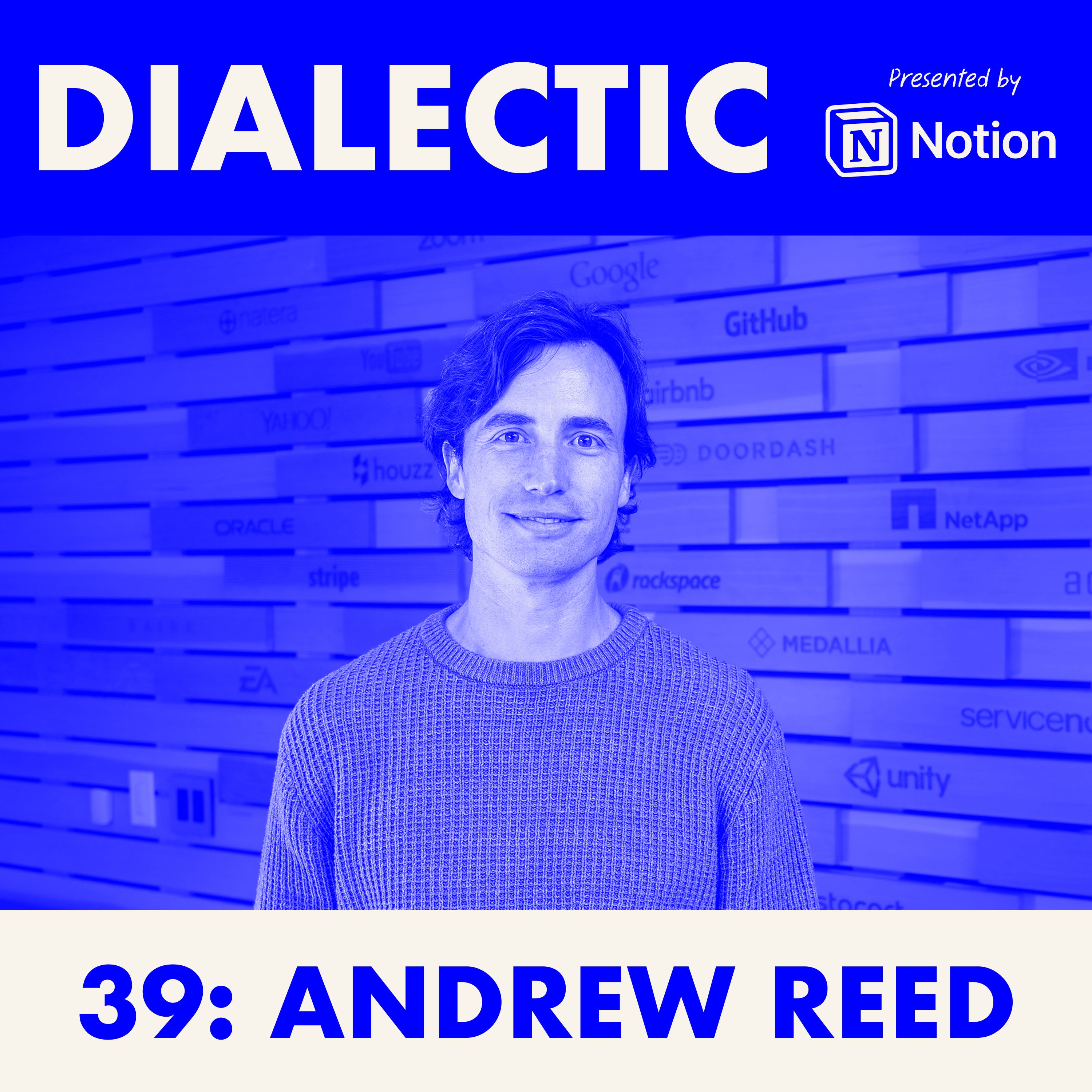
Available on Spotify, Apple, YouTube, and all podcast platforms. Transcript and all links at dialectic.fm.
15 Lessons from Andrew
The founder beats the model. Andrew started his career as a headphones-on excel grinder. He’d now choose founder quality over more financial data every time; the spreadsheets are always wrong in one direction anyway.
There is much to observe when you look. As a kid he struggled with a stutter, so he watched instead of talking. Years of insecurity left him with a rare superpower as an investor: “I have a unique way of seeing the little kid inside people. And I think that helps with trust.”
Don’t flinch. He’d always pictured his big crisis moment in a Park Avenue boardroom. The real one was laps around an empty pool during COVID, wiring a $200 million check as markets cratered, asking himself, “What would the guy you want to be do in this moment?”—and then doing it.
Your first win calibrates everything.** Andrew spent years at Sequoia grinding before getting his first real shot to lead an investment. It was Robinhood. Which meant his idea of “normal”—his internal bar for founders—was set to outlier mode from day one. “If you got four or five companies and one of ‘em is pretty good, you’re playing free.”
Outliers can look broken on paper. You won’t find a great company by screening for one that’s good at everything. The 90th percentile startup trends mediocre. You need one dimension so freakishly strong that it outweighs the flaws.
Great founders become unrecognizable. The person he backed 10 years ago and the person running the company now are borderline different humans. Pedigree and IQ matter, but the real signal is whether someone keeps growing as the stakes and complexity ramp.
Sometimes you know in 14 seconds. When he met Vanta’s Christina Cacioppo, he started rushing through the pitch. Not dismissive, but already decided: “I know it’s good. Let’s get to the part where we figure out the terms.”
The follow-on is the real test. Six months after investing, someone offers five times the price. You’ve attended two board meetings and seen the lowlights up close. That first double-down is one of the hardest calls in investing.
Don’t let frameworks blind you. Andrew avoided the traditional ARR multiple math. Instead: what did you actually add this quarter? Figma at ‘100x ARR’ was really 4x the two-year-out number. Charlie Munger’s corollary: “If you have to actually do the math, it’s too close.”
The memo is the gut check. When he’s truly excited, Andrew sits down and stays up through the night. When he loses the buzz mid-writing, he doesn’t fight it. The act of writing is the conviction test itself.
Reinvent or become a footnote. Sequoia legend Doug Leone spent decades doing enterprise deals, then at 58 bet on a budding Brazilian fintech Nubank that became one of the biggest venture returns in history. “Being willing to look extraordinarily stupid at that stage of your life and then dominating — that ought to be in the ‘how to do this job’ books.”
Advise with grace. Ravi Gupta’s line rings in his head: when an investor asks a founder “Have you thought about X?”, the honest answer is, “There’s nothing you’ve thought about that I haven’t.” Board work is about timing, not theatrics. Earn trust first. Then surface the hard thing with the self-awareness that it’s probably not a new thought.
Watching someone feel it for the first time beats feeling it again. Olympic gold medalist Kristen Faulkner told Andrew that seeing younger Sequoia teammates hit the podium for the first time is better than repeating herself. That stuck with him because it reframed the whole point of staying in the arena once you’ve tasted victory.
Winners put up the numbers. Of Sequoia’s ten tenets, thfe first is performance. In Doug Leone’s words, “if you don’t have the first one, the other nine don’t matter.” Andrew suggests Mike Moritz may be the GOAT: “He put up the numbers more than you could possibly imagine.”
“Lightly, child, lightly.” The world Andrew operates in is intense. Billions of dollars, public scrutiny, founders on the edge. So he references Huxley’s line in his bio: “Learn to do everything lightly. Feel lightly even though you’re feeling deeply.” Simple guidance for a life.
Description
Andrew Reed (X, Website, Sequoia) is a growth investor at Sequoia Capital, where he has invested in companies including Robinhood, Figma, Klarna, Phantom, Vanta, ElevenLabs, Mubi, and Strava. He is quietly one of the best growth investors of his generation.
We begin with how Andrew’s competitiveness and humanity coexist—the twin brother rivalry, the football player who also did musicals, the Goldman analyst who came to value people over spreadsheets. He also shares how an early lack of confidence helped him become a great observer of people and situations.
We talk through his approach to investing: why spreadsheets are “always wrong” in one direction, how he underwriters revenue growth, and what he sees in the world-beaters he invests in. We discuss several of his most formative investments—Robinhood as a 27-year-old’s first check, and again during the first week of COVID; Figma at a price people thought was insane; and a 14-second conviction on Vanta’s—and what each taught him about conviction, timing, and not flinching.
Andrew shares his perspective on serving as a board member, knowing when to double down, closing deals, and how craft can be a commercial input. We also talk extensively about Sequoia Capital and its legendary leaders, from Don Valentine, to Doug Leone and Mike Moritz, to newly-appointed Co-Steward Pat Grady. Andrew reflects on what it means to apprentice at an institution where greatness is the expectation and the champagne toast lasts five minutes.
I hope this conversation inspires you to show up ready for the day you don’t expect, to rise to the stakes rather than shrink from them, and to move through your life and work a little more lightly.
Dialectic is presented by Notion. Notion is an AI-powered connected workspace where teams build their best work. Notion is also where I compile research for episodes and the home of this site where you can find all links and transcripts. My “What are You Building This Year” feature with Notion on Instagram.
Timestamps
(0:00) - Opening Highlights
(2:02) - Intro: Andrew Reed
(3:50) - Thanks to Notion
(5:23) - Start: Humanity, Spotting Weird, and Competitiveness
(19:07) - Investing & Great Founders
(37:53) - Andrew’s Style, Pat Grady, and Continuous Learning
(47:31) - Doubling Down and Not Flinching
(56:09) - Empathy on Boards, Learning the Real Business, “Expensive” Prices, and Selling
(1:07:18) - Managing Ego and Becoming a Leader
(1:14:08) - Craft as a Commercial Input, Knowing vs. Feeling, Preparing for Big Days, Becoming a Great Closer
(1:28:39) - Sequoia Capital
(1:38:57) - Don Valentine, Mike Moritz, and Doug Leone
(1:51:29) - Closing Questions
(1:59:08) - Thanks Again to Notion


