


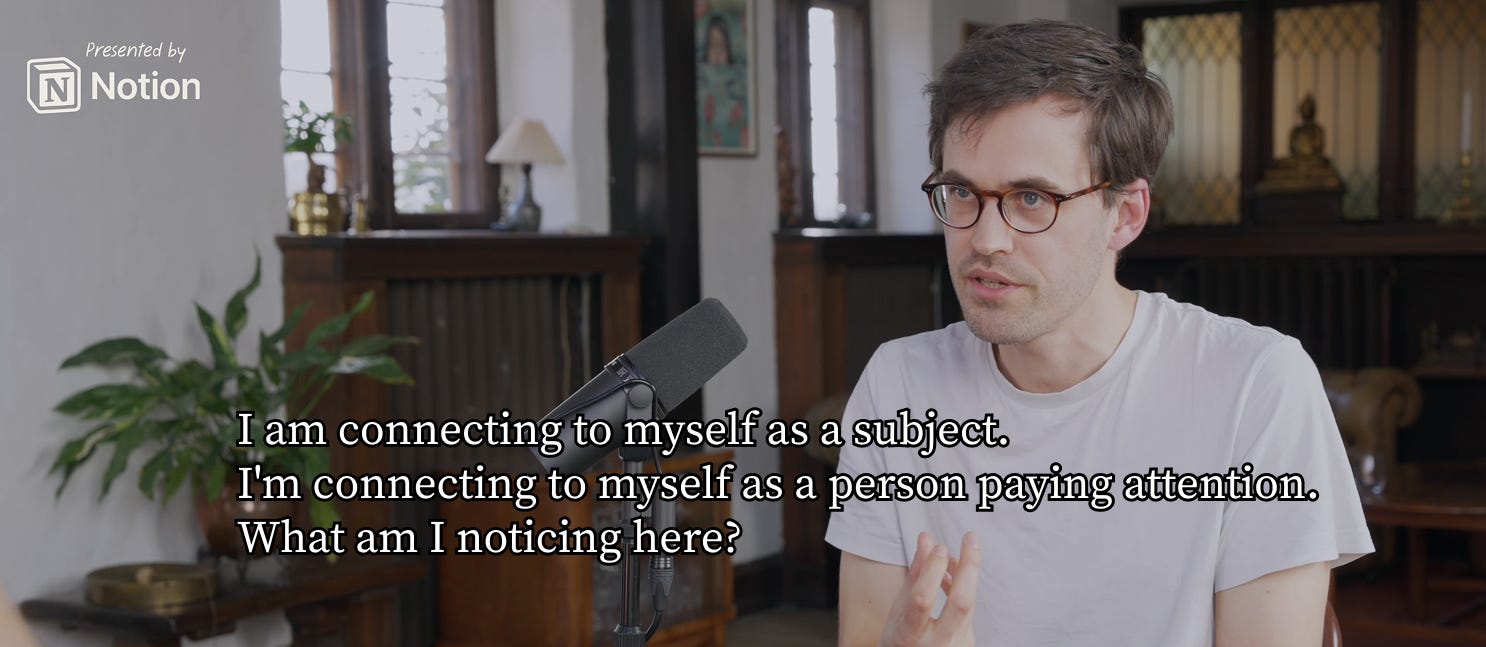
I’ve been thinking a lot about a part of my conversation with Henrik Karlsson. Henrik is one of my favorite people to talk about introspection with, because he is simultaneously attuned to himself and agentic.
His argument (inspired by Nick Cave), is that we ought to flip the direction of our introspection from object to subject.
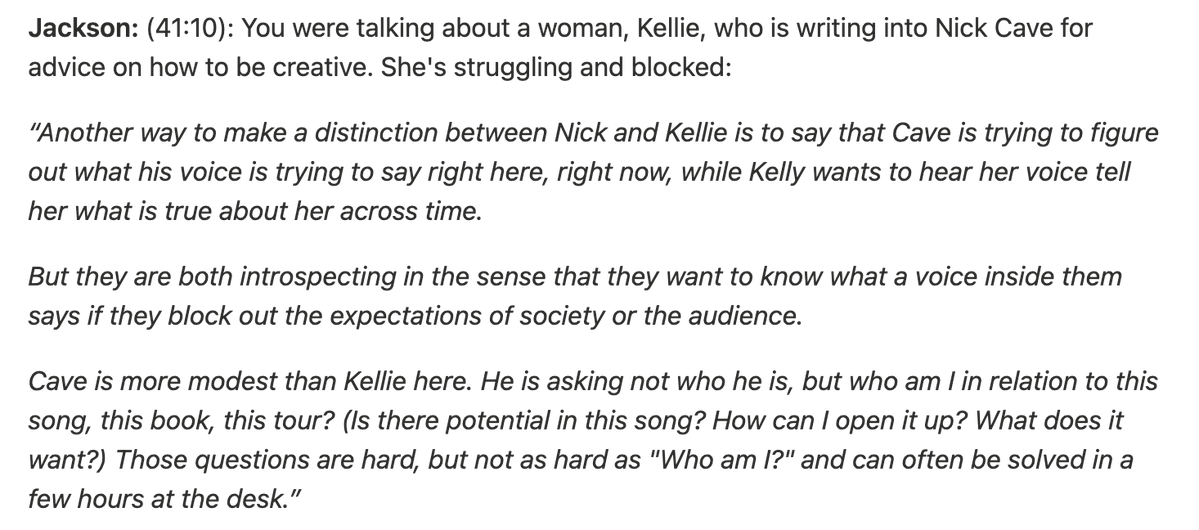
Henrik suggests that we stop obsessively looking in, trying to understand “who am I?” Instead, attend outwards: what am noticing? In this book, this person, this view?
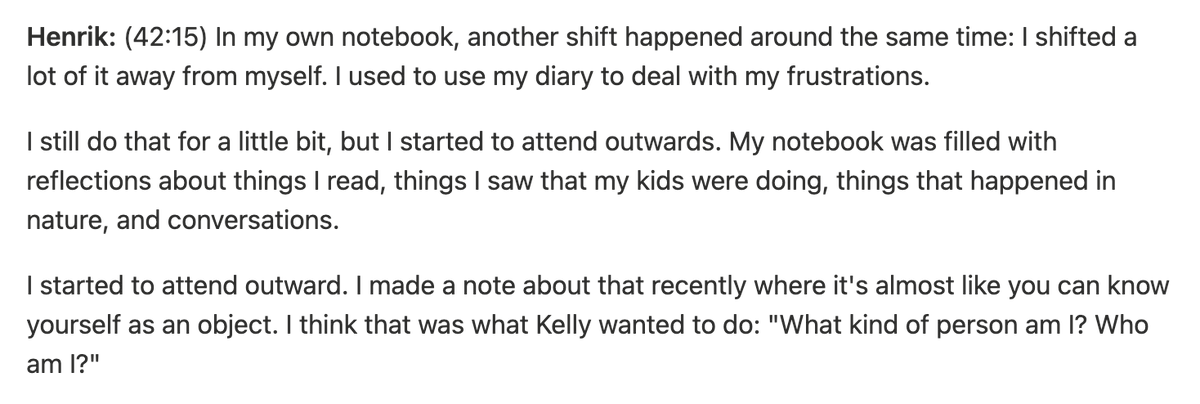
The direction of knowing has inverted. And your world is far richer for it. Instead of becoming a bottomless well of confusion, rumination, and paralysis (as any overly introspective person knows), the world expands.
“connect to [your]self as someone paying attention.”
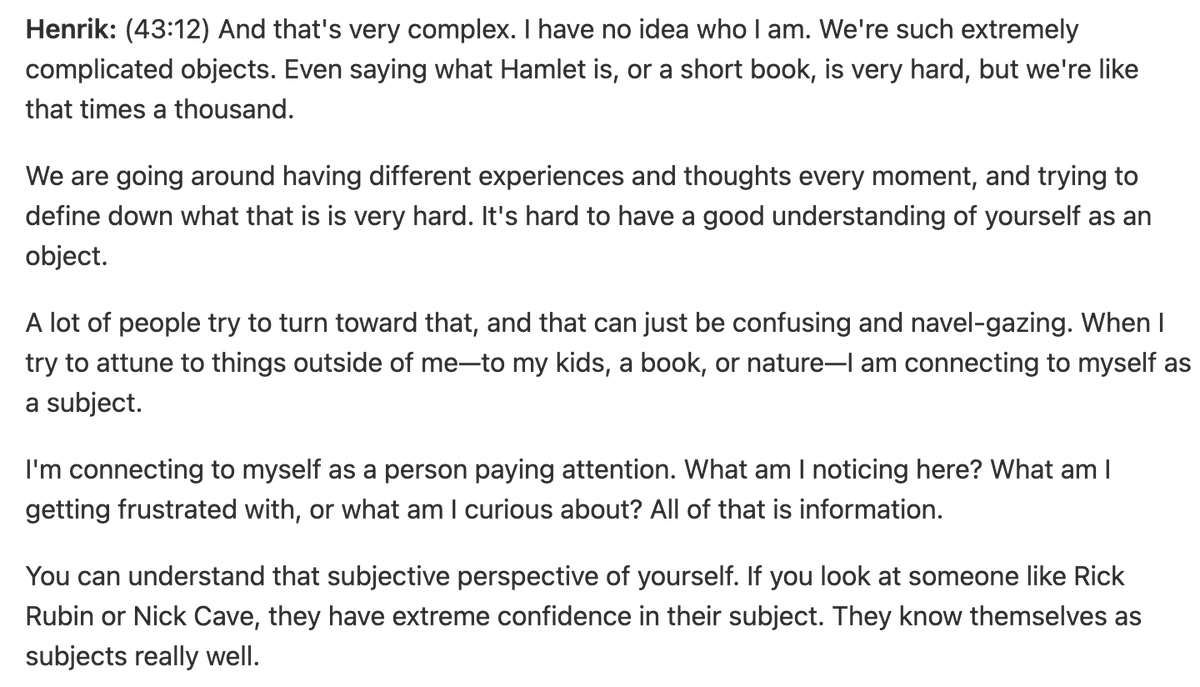
Attention deepens, and richness is everywhere to be found. In the process, we get to know ourselves.
This kind of self-knowing is not selfish, but generous. It also, perhaps paradoxically, creates self-confidence of a different kind:
“You can understand that subjective perspective of yourself. If you look at someone like Rick Rubin or Nick Cave, they have extreme confidence in their subject. They know themselves as subjects really well.”
The people who know themselves in this way act easily. They have a solidity that makes it easy to act upon the world, to create, and that is attractive to be around. That makes others want to notice, too.
A few years ago, I spoke to a hero of mine who has since passed away. He described a last project to “get out from under myself.”
I think about that phrase often. It captures what I think is one of the central aspirations of life.
It rhymes with another favorite bit of wisdom, from David Foster Wallace, in his classic commencement speech (This is Water):
And the world will not discourage you from operating on your default-settings, because the world of men and money and power hums along quite nicely on the fuel of fear and contempt and frustration and craving and the worship of self. Our own present culture has harnessed these forces in ways that have yielded extraordinary wealth and comfort and personal freedom.
The freedom to be lords of our own tiny skull-sized kingdoms, alone at the center of all creation.
This kind of freedom has much to recommend it. But of course there are all different kinds of freedom, and the kind that is most precious you will not hear much talked about in the great outside world of winning and achieving and displaying.
The really important kind of freedom involves attention, and awareness, and discipline, and effort, and being able truly to care about other people and to sacrifice for them, over and over, in myriad petty little unsexy ways, every day. That is real freedom.
How do I do this? How do I escape the skull sized kingdom? How do I get out from under the unbearable weight of the default setting, the mind that is so obsessed with itself?
Well, Henrik’s guidance is a bit of helpful jiu-jitsu. At least for those of us who are so desperate to know ourselves well enough to finally act.
The answers are not in here. They are outward. First with presence and attention, then recognition, and eventually, action. I have found that the action that this kind of self-knowledge produces trends toward service.
Offering something that only you can, because of the distinctive ways you see the world.
Freedom awaits. You only have to look.
Thanks to Henrik Karlsson for inspiring me to look out. You can find our full conversation here:
And Henrik’s original piece on Nick here:
